 Gresham House
Specialist asset management
Gresham House
Specialist asset management
Monthly Monitor | June 2026
Investing amidst speculation
Monthly Monitor: Investing amidst speculation
What is a bubble?
In our view, most global equity markets are currently in a bubble. A bubble is not merely an asset that has risen sharply in price, nor is it simply expensive by conventional metrics. We define a bubble as:
- A condition in which asset prices have diverged by two or more standard deviations from their long run real trend (per Jeremy Grantham).
- The price move is sustained by narrative and momentum rather than a commensurate improvement in underlying cash flow generation.
These definitions have managed to capture all the significant bubbles that we have seen historically. The distinction matters because valuation alone is insufficient. A genuine structural break can exist, and assets can be expensive and stay expensive for extended periods if the earnings base is genuinely expanding to meet the price.
What separates a bubble from just expensiveness is the expanding gap between price and a fundamental anchor. We believe in capitalism and in the mean reversion of profit margins (exceptionally high or low margins revert to long term trend), so we tend to use revenue-based measures as an anchor.
Is this a bubble?
In our view, yes. AI adjacent companies, and in particular semiconductors are in a bubble. Therefore, the US market is in a bubble due to the high weighting of AI adjacent companies in the index. By extension this has brought global equity markets into bubble territory due to the high weighting of the US in the index. We now have extended valuations that are not anchored by cash flow generation.
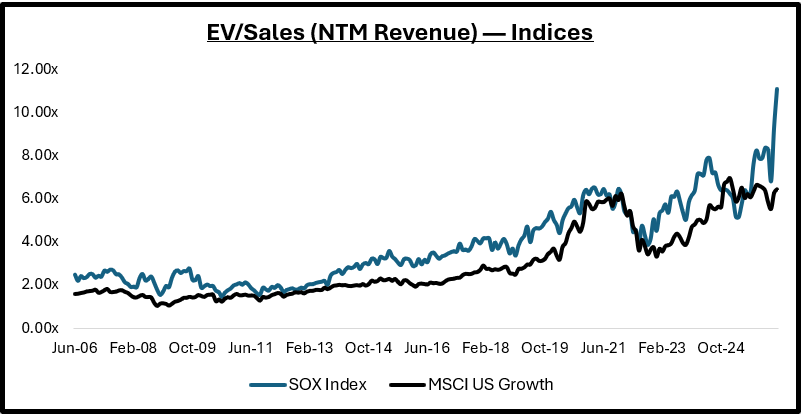
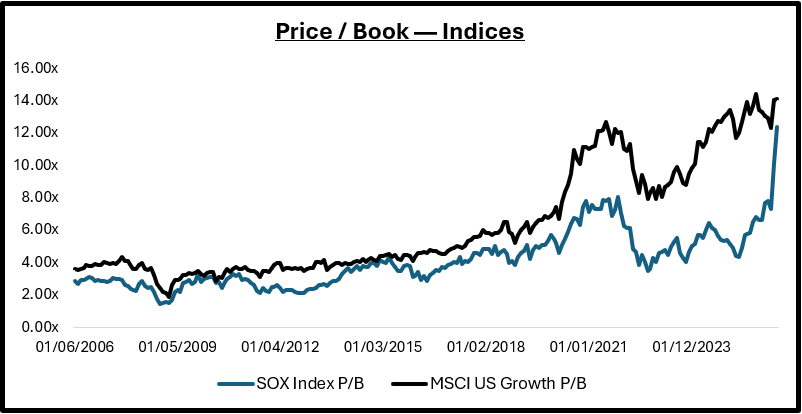
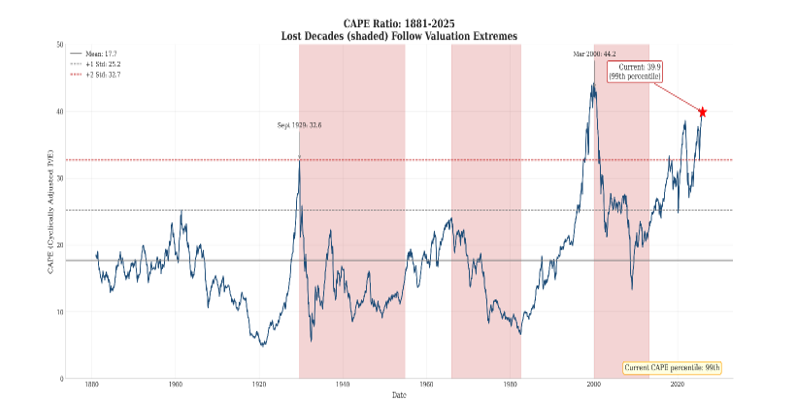
On a Shiller P/E (price to ten-year inflation adjusted earnings) the US figure of 40x is in the 99th percentile of observations. At these levels the air is extremely thin. This is the mother of all bubbles.
Why investors need to pay attention:
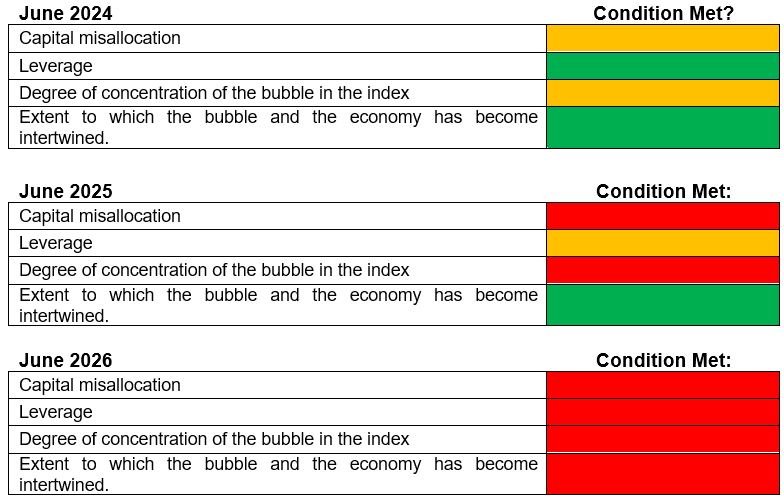
Whether investors can ignore a bubble or not is a function of:
- Capital misallocation
- Leverage
- The degree of concentration of the bubble in the index and
- The extent to which the bubble and the economy has become intertwined
The seriousness of a bubble is not determined by the reality or otherwise of the underlying technology. The biotechnology bubble of a decade ago hit none of these classifications and caused no broader issues.
Railways, electricity, radio, and the internet were all transformative, but they hit these classifications and all produced catastrophic bubbles.
Capital Misallocation:
Capital expenditure by Microsoft, Alphabet, Amazon, Meta, and Oracle (hyperscalers) is projected to exceed $600 billion in 2026, with similar levels in each of the three subsequent years. To put this in proportion: Goldman Sachs estimates cumulative US data centre spending will reach $3 trillion by 2029, and McKinsey $5 trillion by 2030. $5 trillion is 18% of 2025 US GDP.
Against this massive capital spend there is no profit base and very little revenue base. OpenAI, the flagship application, is projected by its own forecasts to lose $17 billion in 2026 and $35 billion in 2027, with losses doubling annually despite revenue growth.
By our back of the envelope maths, to reach their current operating margins on the capital spend for 2026 the five hyperscalers will need an additional $400bn of revenue within a year.
Julien Garran of MacroStrategy Partners estimates the scale of capital misallocation in the US economy at two thirds of GDP. He defines this as capital not making a return.
Leverage
We were quite comfortable ignoring the AI bubble and going about our business as usual until leverage got involved. Until 2025, the hyperscalers funded capex from operating cash flow. That has changed materially.
Hyperscalers’ quarterly free cash flow has declined from a peak of approximately $50 billion in mid-2024 to near zero by Q1 2026 as capex absorbs an ever-larger share of earnings. This is worrying but at least it is transparent. What has happened in the shadows is more concerning, namely off-balance sheet financing. Hyperscalers are using data centre infrastructure as collateral in special purpose vehicles where their own contracted lease payments service the purchasing of off-balance sheet assets? Meta’s $30 billion Hyperion data centre is 80% off-balance sheet. Apollo and Blackstone provide $36 billion to finance Google TPUs leased to Anthropic through an SPV. Annual issuance of debt tied to AI and data centres rose from $166 billion in 2023 to $625 billion in 2025, according to Reuters a near-fourfold increase in two years. ABS tied to data centres rose nineteen-fold between 2022 and 2025. The appeal of the special purpose vehicle structure is that the debt amortises slowly (Hyperion runs to 2049 fully amortising over 20 years) making the lease payments look like manageable operating expenditure. The collateral securing the debt is a mix of the data centre shell (land, power, cooling, building) which genuinely have long useful lives and chips which are obsolete in increasingly shorter cycles but are being depreciated over an increasingly longer useful life. This increasingly looks like accounting optics to flatter earnings whilst the special purpose vehicle structure flatters on-balance sheet leverage.
The degree of concentration of the bubble in the index:
MSCI World now allocates 72% to US equities. 44% of S&P 500 capitalisation, over a quarter of total world market capitalisation, is accounted for by just 30 AI-linked names. The eight largest companies globally are all AI participants bar Apple.
This concentration and the fact that passive investing has exploded in size was absent from previous technology bubbles. In 2000, Nasdaq held the concentration risk and a passive global equity investor could avoid it. Today, there is no passive escape. A sustained valuation correction in the hyperscalers would mechanically impair returns for every pension fund, insurer, and sovereign wealth fund running market-cap allocation.
The extent to which the bubble and the economy has become intertwined
Three-quarters of Q1 2026’s annualised US GDP growth came from AI-related fixed investment and software. Strip that out, and the rest of the economy shrank. This is the same dynamic seen in every major infrastructure bubble. The construction cycle itself becomes the economic engine.
Lower-income households are managing spend paycheck-to-paycheck. The K-shaped economy is widening: the top decile is fine, the rest is under significant strain. The wealth effect from elevated equity prices supports upper-income consumption, the removal of that effect in a bubble correction would be rapidly transmitted into the real economy.
Evolution of the severity conditions:
How this resolves itself?
This is unknowable and as anyone who lived through the property boom in Ireland can attest to bubbles can last longer than anyone thinks possible. As JM Keynes said, “The market can stay irrational longer than you can stay solvent.”
Our base case for how this bubble ends is in capex return disappointment. We believe that revenue growth from the hyperscalers fails to demonstrate the necessary return on their capital expenditure programmes over two or three quarters. This requires only that revenue growth comes in under expectations. When the market notices this deterioration in expectations the de-rating can be sudden. This scenario likely unfolds over 12-24 months. Capital is not destroyed overnight. Projects are delayed, scaled back, or abandoned. Potential peak-to-trough declines: 50-70% in the semiconductor complex, 30-40% in the hyperscalers from current levels. The broader US equity market, given its 72% US weight and AI concentration, would face structural multiple compression.
Other triggers for how this unravels include bond market stress, technology substitution (like the DeepSeek shock), and private credit stress.
The bull case:
The bull case for AI is worth examining as the technology adaption has been incredibly fast paced. The bull case is made up of three elements. Real hyperscaler profitability, revenue acceleration and a massive potential revenue pool (massive total addressable (TAM)) are what the bull case rests on.
The first element of the bull case is that the hyperscalers are genuinely profitable businesses with demonstrated earnings power. Microsoft, Alphabet, Amazon, and Meta are not the same as the concept companies such as Pets.com that we saw during the dotcom bubble. Consumers encounter these companies daily and they generate hundreds of billions in revenue. The AI investment is being made from a position of financial strength. The bulls note that this is not a no-earnings mania.
The second element of the AI bull thesis is that it is already generating measurable revenue acceleration. The bulls argue that a demand ramp is in progress.
The third element is the TAM argument. If AI can automate even a fraction of knowledge work at scale, the economic value created dwarfs the infrastructure investment required.
Each element of the bull case is real, but none is sufficient to account for what the current valuation levels are implying.
On real earnings, the existing business is not the issue. The question is whether the $600 billion of annual new investment earns an adequate return. Earnings-based bubbles are different from no-earnings manias, but the railway mania was also an earnings bubble. The railways generated real revenues, but the incremental capital deployed was a malinvestment. Will the incremental capital deployed into a booming industry earn sufficient returns. Investors bought the hyperscalers’ shares as these businesses had capital light business models and were kicking off significant levels of free cash flow. These are now capital heavy businesses who risk being disrupted and their free cash flows have been eaten up capital expenditures.
On revenue acceleration, the numbers are real but after three years and hundreds of billions spent by the best software developers in history there is still no profitable commercial mass-market LLM application. OpenAI’s own projections show losses doubling annually to $35 billion by 2027 despite the revenue growth that has the bulls excited.
The TAM for intelligence may be large, but we are lacking in specifics. From what we can see the evidence is increasingly suggesting that small, specialised models are winning at a fraction of the infrastructure cost.
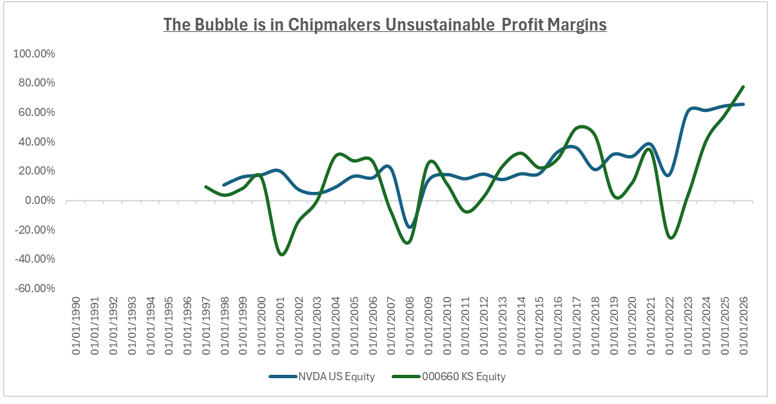
In all prior technology manias, the underlying technology was transformative, the early revenue was real, the TAM was huge. None of that prevented the capital cycle from kicking into action and destroying wealth when the incremental return on capital failed to meet the cost. The AI cycle has all the same ingredients, and potentially is the greatest capital investment bubble of all time. Demand will either fall or supply will come on, margins will prove unsustainable and share prices of the semiconductor companies and the hyperscalers will reflect this new reality.
How to invest during a bubble:
The practical challenge is that the bubble could continue inflating for longer than rational analysis supports. It has not broken yet.
For a fund running a patient contrarian value philosophy, the relevant question is not whether the bubble continues but how to build a portfolio that earns a structurally sound return from the current dislocation without depending on a specific timing call.
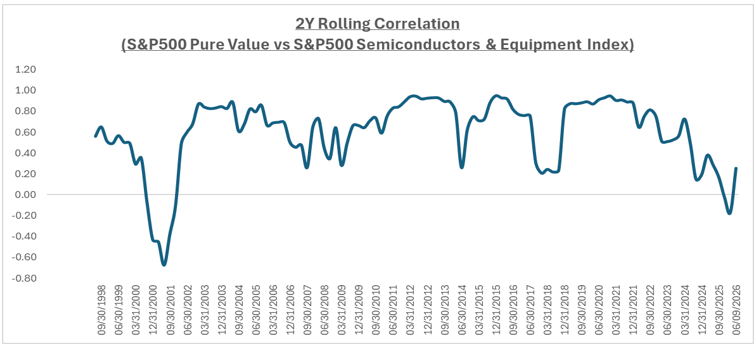
The chart below shows the correlation collapse between value and semiconductors precisely mirrors the entry points for the two largest value outperformance cycles of the last 30 years. S&P’s dispersion index has recently spiked to dotcom/GFC levels. In our view this is evidence that the market is creating large areas of opportunities in stocks excluded from the AI narrative.
The flipside of capital rushing to perceived AI winners is that significant areas of the market have become neglected. Many sound businesses have seen significant declines in both relative and absolute terms. This is exacerbated by the dominance of pod shops (instead of one portfolio manager running one fund, a fund allocates capital to many separate teams, or “pods”) and 0-day expiry options activity. The increasing dominance of passive investing directs new flows continuously to the largest AI-narrative names regardless of valuation, mechanically compounding the dislocation in everything else.
The characteristics we are looking to target are cheap valuations, capital starved, conservative balance sheets, dividend track records, competitive models that are not AI-contingent in either direction, and businesses whose revenues are structurally independent of the data centre build cycle. The mispricing of these businesses is extreme and will resolve over the medium term.
On the multi asset side we believe OECD bonds are effectively dead. We are hedging with a combination of energy, precious metals, non-OECD bonds from fiscally responsible countries and forestry.
Conclusion:
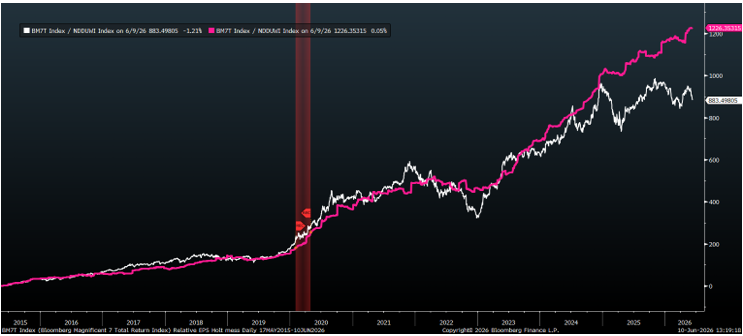
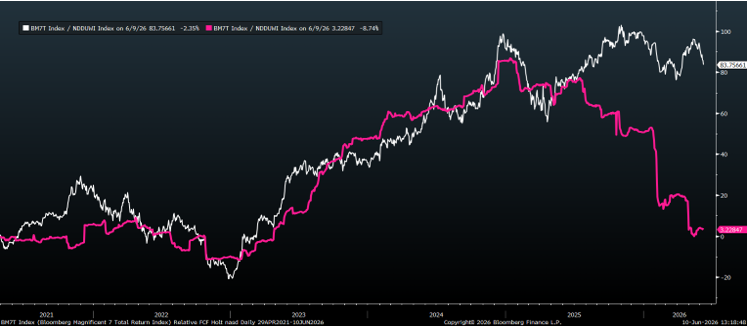
Our argument can be summed up in three Bloomberg charts.
The first chart shows the relative forwards earnings of the Magnificent 7 vs the Index and the relative price of the Magnificent 7 vs the Index. This is telling us to believe that the Magnificent 7 are going to earn fantastic returns from AI, that they are not going to be disrupted and that they will all be winners.
The second chart shows the relative cash flows. This is what we believe. The cash flows will not derive a commensurate return and there will be significant write downs. The Magnificent 7 will only reassert themselves when they announce capex reductions like Meta did when it abandoned the Metaverse.
The third chart shows semiconductor margins. We believe the semiconductor industry has two ways to lose. Demand stays strong but supply comes on and crushes margins. Demand weakens as investors in the hyperscalers demand capex cuts at the same time supply comes on, in this scenario these companies become loss making.
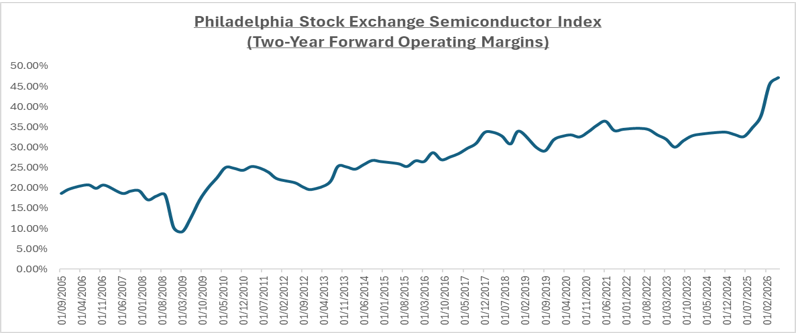
What happens in the AI bubble will impact investment returns for many years to come. We believe the bubble will burst and investors’ portfolios will be damaged. The good news is that the areas of the market that have not been affected by the mania will provide a decent home for capital while the pain unfolds. Our portfolios are aligned with this view, and our fund managers are invested in the funds??

Derek Heffernan
Chief Investment Officer
Any views and opinions are those of the Fund Managers, this is not a personal recommendation and does not take into account whether any financial instrument referenced is suitable for any particular investor.
Capital at risk. If you invest in any Gresham House funds, you may lose some or all of the money you invest. The value of your investment may go down as well as up. This investment may be affected by changes in currency exchange rates. Past performance is not necessarily a guide to future performance.
The above disclaimer and limitations of liability are applicable to the fullest extent permitted by law, whether in Contract, Statute, Tort (including without limitation, negligence) or otherwise.
Want to keep up to date?
Subscribe using the form below to receive updates on our Monthly Monitor.